
The Ministry of Statistics and Programme Implementation (MoSPI) released two thematic SDG Bulletins:
- Planet in Focus: Advancing Environmental Sustainability under the Sustainable Development Goals (SDGs)
- Delivering Prosperity at Scale: India’s Economic Transformation through the SDGs
They were released during Capacity Building Workshop on Monitoring Frameworks of SDGs Compilation of Environment Accounts, and Gender Statistics, held in Patna, Bihar.
Background: About Bulletins
- They are part of a new series of thematic, data-driven SDG bulletin reports aligned with the five foundational pillars of the 2030 Agenda for Sustainable Development—
- People
- Planet
- Prosperity
- Peace
- Partnerships
- Objective: To provide a concise and accessible overview of India’s progress on SDGs by synthesizing key indicators, policy initiatives, and national achievements.
- Prepared using the latest official data presented in the “Sustainable Development Goals – National Indicator Framework (NIF) Progress Report, 2025” released by MoSPI
- This report serves as the primary statistical framework for monitoring SDG progress in India.
- Through these thematic bulletins, MoSPI seeks to enhance awareness and provide a data-driven overview of India’s progress on the SDGs.
- They present key insights on national achievements, policy frameworks, and flagship programmes that contribute to India’s advancement across SDG goals under Planet and Prosperity pillars.
Planet in Focus: Advancing Environmental Sustainability under the SDGs
- It highlights India’s progress toward environmental sustainability, focusing on SDGs related to
- Clean water and sanitation (SDG 6)
- Responsible consumption and production (SDG 12)
- Climate action (SDG 13)
- Life below water (SDG 14)
- Life on land (SDG 15)
- It outlines key environmental priorities such as climate mitigation and adaptation, sustainable water management, biodiversity conservation, and sustainable consumption practices.
- It also documents major national initiatives and policy frameworks supporting environmental sustainability, along with India’s leadership in global climate and environmental governance.
India’s Transformative Leadership in achieving the Planet Dimension of the SDGs:
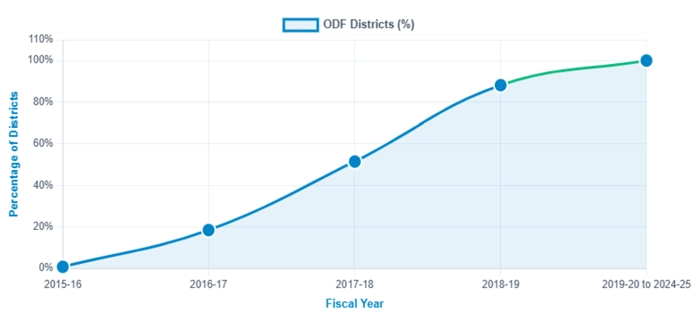
- India achieved universal, fully sustained Open Defecation Free (ODF) status across all districtsthrough the transformative Swachh Bharat Mission (SBM).
- Percentage of Districts achieving Open Defecation Free (ODF) target
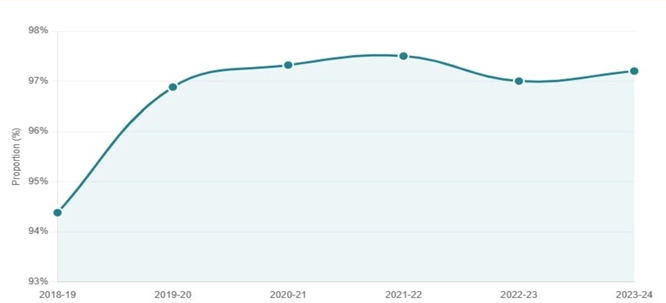
- India’s commitment to gender-sensitive school sanitation links infrastructure with equity and girls’ education.
- 97.2% of schools having gender-segregated toilets in 2023–24, reflecting strong progress.
- Proportion of schools with separate toilet facility for girls
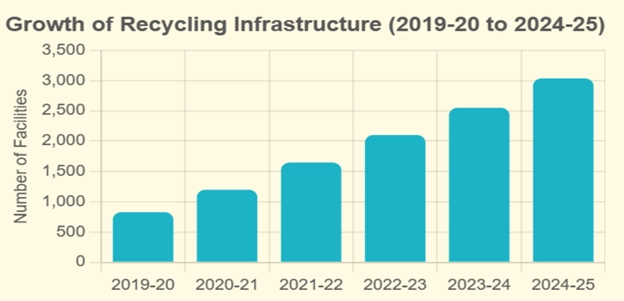
- Waste recycling infrastructure expanded significantly from 829 facilities in 2019–20 to 3,036 facilities in 2024–25, indicating a large-scale transition towards sustainable consumption and production.
- Number of waste recycling plants installed
- Bulletin also reflects India’s rapid advancement in disaster risk reduction reflects a systemic, forward-looking transformation aimed at strengthening national resilience in alignment with the Sendai Framework for Disaster Risk Reduction (2015–2030).
Delivering Prosperity at Scale: India’s Economic Transformation through the SDGs
- It examines India’s progress in fostering inclusive and sustainable economic growth, highlighting developments across SDGs linked to economic opportunity and well-being, including
- Affordable and clean energy (SDG 7)
- Decent work and economic growth (SDG 8
- Industry, innovation and infrastructure (SDG 9)
- Reduced inequalities (SDG 10)
- Sustainable cities and communities (SDG 11).
- Underscores the role of inclusive economic policies, infrastructure development, entrepreneurship, innovation in advancing broad-based prosperity in India.
India’s progress in the Prosperity dimension towards inclusive and sustainable growth:
- India is the fourth-largest global wind energy producer.
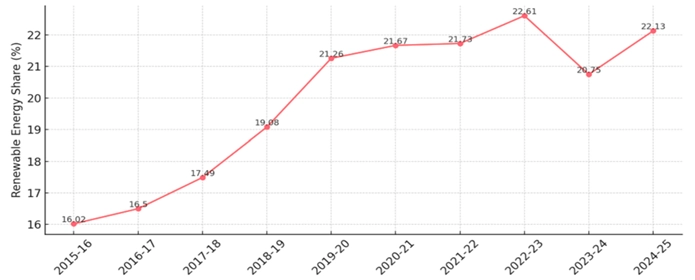
- Share of renewable energy in total installed electricity generation capacity has increased from 02% in 2015–16 to 22.13% in 2024–25.
Renewable energy share in the total installed electricity generation
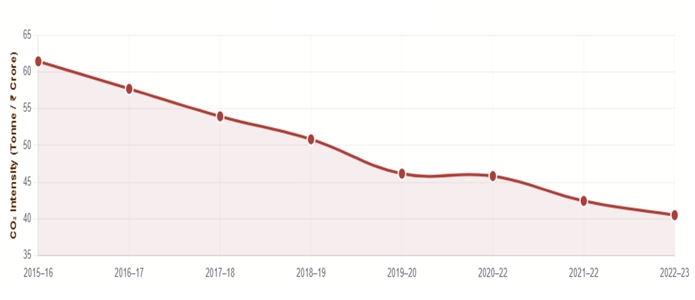
- Carbon intensity of the power sector declined from 45 tonnes CO₂ per ₹ crore in 2015–16 to 40.52 tonnes in 2022–23, reflecting a sustained transition towards low-carbon growth.
- Total CO2 emissions of power sector per unit of GDP
- It also highlights sharp trajectory households’ electrification from 99.77% to 100% in just 24 months demonstrates the accelerated pace of last-mile connectivity.
- Digital connectivity has expanded significantly, with over 99% populationcoverage under mobile networks, enabling inclusion across sectors.
- India’s tourism sector has demonstrated structural ladder and becoming a core driver of inclusive growth, employment generation, and foreign exchange earnings, contributing 2.60% to GDP and reaching ₹6,99,66,624 lakh in 2022–23.