
A fresh diplomatic and strategic tussle has emerged between India and China over the Shaksgam Valley in Jammu and Kashmir, reviving concerns despite recent disengagement after the eastern Ladakh standoff. The valley’s proximity to Siachen Glacier, China’s Xinjiang, and Pakistan-occupied Kashmir (PoK) makes it a highly sensitive zone for India’s national security.
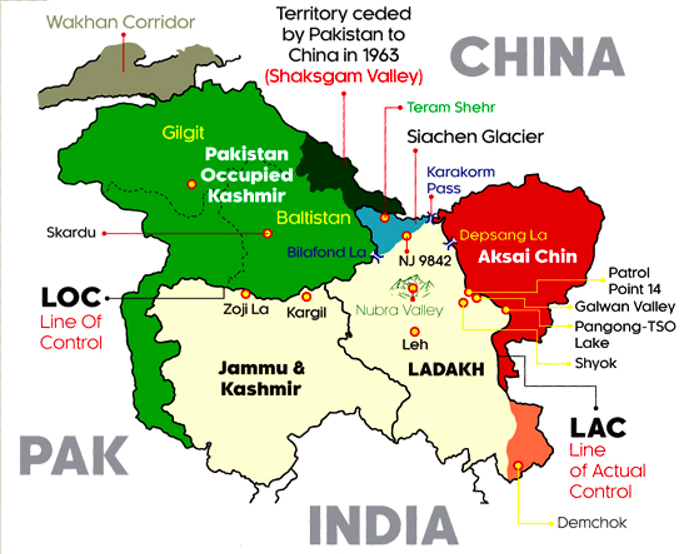
Shaksgam Valley: Location & Geographic Context
- Also known as the Trans-Karakoram Tract
- Area: ~5,000–5,180 sq km
- Terrain: High-altitude, harsh, sparsely inhabited
- Location:
- North of Siachen Glacier
- Between Karakoram and Kunlun mountain ranges
- Lies in Hunza–Gilgit region of PoK
- Claimed by India, administered by China as part of Xinjiang (Taxkorgan & Yecheng counties)
Why Shaksgam Valley Is Strategically Critical for India
- Siachen Linkage:
- Siachen is the world’s highest battlefield.
- Control enables monitoring of Pakistan from the south and China from the north.
- Karakoram Pass Proximity:
- Strategic observation point for Chinese movements between Xinjiang and Tibet.
- Dual Boundary Sensitivity:
- Impacts both:
- Line of Control (LoC) with Pakistan
- Line of Actual Control (LAC) with China
- Impacts both:
- Any infrastructure or troop movement in Shaksgam directly affects India’s defence posture in Ladakh and Siachen.
China’s Expanding Infrastructure Footprint
- China is following a “salami slicing” strategy:
- Incremental, small actions that cumulatively alter ground realities in disputed regions.
- Key development (by mid-2024):
- Completion of a road across the Aghil Pass (4,805 m) into Lower Shaksgam Valley.
- Chinese construction teams and potential patrols now operate within ~50 km of Indira Col, near Indian-held Siachen.
- Nearly 75 km of all-weather road (~10 m wide) reportedly completed.
- Infrastructure is linked to the China–Pakistan Economic Corridor (CPEC).
Emerging Two-Front Security Challenge
- Earlier, India’s Siachen focus was primarily Pakistan-facing.
- China’s new access from the north creates:
- A potential two-front contingency on the highest battlefield.
- Greater coordination risk between China and Pakistan.
- Reinforces India’s long-standing concern over collusive pressure.
Pakistan’s Cession of Shaksgam Valley to China (1963)
Historical Background
- Pre-1947:
- Shaksgam Valley historically linked to Baltistan/Ladakh (Balti & Ladakhi place names).
- British-era maps showed it as part of Jammu & Kashmir, though borders with China were undefined.
- 1936:
- Under British influence, the Mir of Hunza surrendered rights over Taghdumbash Pamir and Raskam Valley, but Shaksgam & Aghil range remained under Hunza.
- Post-1947:
- After J&K’s accession to India, Shaksgam legally became Indian territory.
- Pakistan’s occupation of adjacent areas prevented India from exercising control.
Sino-Pakistan Frontier Agreement (1963)
- Signed on 2 March 1963 between China and Pakistan.
- Pakistan ceded ~5,180 sq km of Shaksgam Valley to China.
- Article 6:
- Boundary is temporary and subject to renegotiation after final settlement of the Kashmir dispute.
- India rejected the agreement as illegal:
- Pakistan had no legal authority to transfer Indian territory.
China’s Entry & Strategic Calculus
- 1950s: China moved into eastern Hunza, worsening India–China relations.
- Pakistan under President Ayub Khan sought closer ties with China, ignoring Indian objections.
- Since Doklam (2017), China has intensified military and logistics infrastructure in Shaksgam.
Current Status of Shaksgam Valley
- Administered by: China (Xinjiang)
- Claimed by: India (Union Territory of Ladakh)
- Pakistan’s role:
- No longer controls the area
- Continues to defend the 1963 agreement
- Ground reality:
- Rapid Chinese infrastructure expansion
India’s Official Position
- India maintains that:
- Pakistan illegally ceded Indian territory to China in 1963.
- Shaksgam Valley remains part of Jammu & Kashmir.
- Ministry of External Affairs (MEA):
- Asserted India’s sovereignty over the valley.
- Stated India reserves the right to take “necessary measures” to safeguard its interests.
China’s Position & Contradictions
- China claims:
- Its construction activities are legitimate.
- Contradiction:
- China calls Kashmir a bilateral issue between India and Pakistan, yet:
- Actively develops infrastructure in PoK-linked territories.
- China calls Kashmir a bilateral issue between India and Pakistan, yet:
- Highlights:
- Continued geopolitical tension in the western sector of the India–China boundary.
- Strategic assertiveness despite disengagement elsewhere.